

Formentera, 25 August 2026
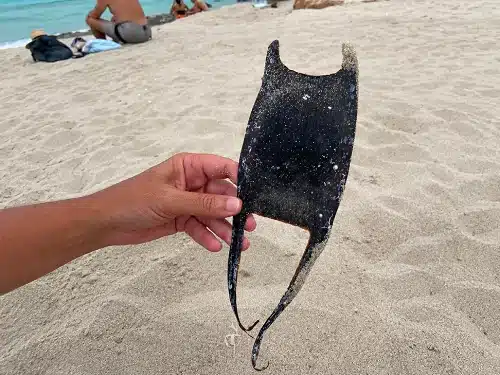
Last July, I was spending the afternoon on La Fragata beach in Migjorn when I spotted something on the shore that caught my attention. At first, I thought it was one of the face masks we used so much during the Covid pandemic, so I went over to pick it up and throw it in the bin.
But when I touched it, I realised it wasn’t what I had thought. In fact, it was either a shark egg or a ray egg, as my good friend and experienced diver Jose Antonio Arribas confirmed after I sent him the photo. The discovery got me thinking about writing a post about the current situation of sharks and rays in the waters around Formentera, where their numbers appear to be particularly low and therefore a cause for concern.
So I looked into the subject and discovered Shark Med, a Mallorca-based non-profit organisation dedicated to the recovery and conservation of sharks in the western Mediterranean.
Despite the unease they can cause among swimmers, large marine predators play an essential role in marine ecosystems. Sharks are at the top of the food chain and help regulate populations of other species, meaning their disappearance can trigger major imbalances in the marine environment.


Shark Med
The organisation studies shark populations using non-invasive scientific techniques. The data collected provides a better understanding of species that are difficult to observe because of their behaviour, movements and the great depths at which they live.
The organisation believes that expanding scientific knowledge is essential to drive changes in fisheries policies and improve protection measures. At the same time, its research helps challenge the negative image traditionally associated with sharks and explain the important role they play in keeping our seas healthy.


Environmental DNA
Shark Med’s research uses environmental DNA analysis, a technique that makes it possible to identify the presence of species through the genetic material they leave behind in the water, without having to capture them. The study analysed 80 valid samples collected over the course of a year, with surveys carried out every two months, and found no shark or ray DNA.
Shark Med believes that the absence of certain species throughout the entire study period indicates that their populations are extremely low. It also points out that many sharks are highly migratory, meaning that marine protected areas are not enough if the animals are exposed to threats once they move beyond their boundaries.
Threats to their recovery
Fishing pressure is one of the main factors behind the decline of sharks and rays in the Mediterranean. These species have very low reproductive rates, with long gestation periods and few offspring, making it extremely difficult for their populations to recover when fishing pressure is high.
For decades, sharks have also been regarded as competitors by the fishing industry because they feed on commercially valuable species. In addition, some sharks are used by industries such as the cosmetics and pharmaceutical sectors, particularly for the oil extracted from their livers.
Imbalances in the Mediterranean
The disappearance of sharks and rays has consequences that go far beyond the species themselves. As they occupy the upper levels of the food chain, they help control other populations and maintain the balance of the ecosystem.
When large predators decline, some of their prey can increase excessively, triggering a cascade of changes. These imbalances contribute to the degradation and desertification of the seabed, a phenomenon that can already be seen in some marine reserves in the Balearic Islands.
The deterioration of the ecosystem can also affect essential habitats such as Posidonia oceanica meadows, which are vital for Mediterranean biodiversity and carbon storage.
Shark Med’s findings therefore reinforce the need to expand scientific research and adopt conservation measures that extend beyond the boundaries of marine reserves. Protecting sharks and rays means conserving threatened species, but it also means safeguarding the balance and health of the Mediterranean.
And now that I have learned all this about sharks and rays in the waters around Formentera, I am even happier to have found what I initially thought was rubbish washed up on the shore, but which turned out to be evidence that a shark or ray had laid its eggs in one of the Posidonia meadows surrounding the island’s coastline.

I’m Ramón Tur, the person behind everything written and photographed on this website about Formentera. I discovered the island in 1972 when my parents, aboard the mythical Joven Dolores, took me on vacation from Ibiza for the first time, and it was love at first sight that has only grown stronger over time, making Formentera my place of residence for many years now. If you wish, you can follow me on Instagram @4mentera.com_
If you're planning to visit Formentera, make sure to check out our discount codes section first.


