

Formentera, 6 September 2026
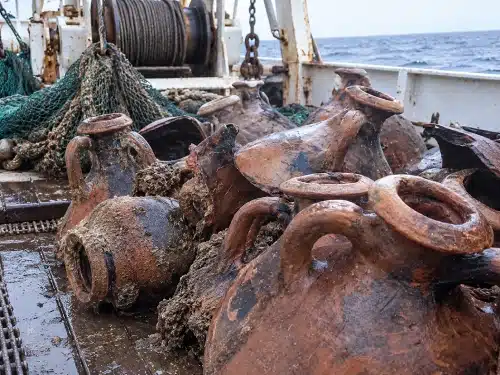
The waters south of Formentera were the scene of a remarkable archaeological discovery a few days ago during a scientific survey dedicated to studying fishery resources in the Mediterranean. Dozens of clay amphorae, believed to date from Roman times, were accidentally brought up from the seabed during work carried out by an oceanographic research vessel.
The vessels reached the surface during one of the scientific fishing operations conducted as part of the MEDIAS survey. Many of the pieces were remarkably well preserved despite the length of time they had spent underwater, and some still retained sediment that had accumulated over centuries.
Initial estimates made on board dated some of the amphorae to between the 2nd and 3rd centuries AD, although experts will need to confirm this chronology.
The discovery also has a direct connection with the Pityusic Islands, beyond the fact that it was made in waters close to Formentera. The authorities determined that the recovered artefacts should be deposited at the Archaeological Museum of Ibiza and Formentera, where they can be examined to learn more about their origin and historical context.


During a Scientific Survey
The amphorae were discovered during the 18th edition of the MEDIAS survey (Mediterranean International Acoustic Survey), a programme designed to assess the biomass of species such as sardines and anchovies in Mediterranean waters.
It was during one of the operations at sea that the nets brought a completely unexpected haul to the surface: dozens of large ceramic vessels which, based on their characteristics, were initially identified as possible Roman amphorae.
In fishing terminology, each of these operations is known as a “haul”, referring to the process of deploying and subsequently retrieving the fishing gear. On this occasion, a routine research operation unexpectedly turned into a major archaeological discovery.
The pieces were hoisted onto the deck and placed in safe custody to ensure their protection. The discovery was also reported to the relevant authorities so that the appropriate procedure could be determined.


1,800 Years Old
Initial observations following the recovery suggested that the vessels dated from Roman times. Those on board considered that their more globular shape could indicate that they were amphorae from the 2nd or 3rd centuries AD.
One of the most striking features was an inscription visible on at least one of the pieces, in which the letters “FPATERN” or “FPATERNI” could be made out. Its meaning and possible connection with the place of manufacture or the producer will now need to be studied by specialists.
Amphorae were among the most widely used containers in Roman times for transporting goods across the Mediterranean. They were used to carry products such as oil, wine, sauces and salted fish. Merchant ships could transport hundreds or even thousands of these vessels stacked in their holds.
Archaeological Museum of Ibiza and Formentera
After the discovery was reported, the Ministry of Culture determined that the amphorae should be deposited at the Archaeological Museum of Ibiza and Formentera. The decision complies with Law 16/1985 on Spanish Historical Heritage, which regulates the procedure to be followed in the event of chance archaeological discoveries.
Once the amphorae have been handed over to the bodies responsible for their safekeeping and conservation, specialists can begin the work of establishing their date, provenance and characteristics. The exact location of the discovery is also of particular interest, as it could provide information about navigation and the trade routes that crossed the waters around the Pityusic Islands during Roman times.
The Miguel Oliver Research Vessel
The discovery was made aboard the Miguel Oliver, an oceanographic research vessel operated by the General Secretariat for Fisheries and based in the port of Vigo. It entered service in 2007, is 70 metres long and takes part in various scientific surveys in Spanish waters.
Its mission in the Mediterranean is to study fishery resources as part of the MEDIAS survey, rather than to carry out archaeological work. However, it was one of these scientific operations that accidentally led to the recovery of artefacts that had remained beneath the sea for centuries.

I’m Ramón Tur, the person behind everything written and photographed on this website about Formentera. I discovered the island in 1972 when my parents, aboard the mythical Joven Dolores, took me on vacation from Ibiza for the first time, and it was love at first sight that has only grown stronger over time, making Formentera my place of residence for many years now. If you wish, you can follow me on Instagram @4mentera.com_
If you're planning to visit Formentera, make sure to check out our discount codes section first.


