

Formentera, 24 March 2026
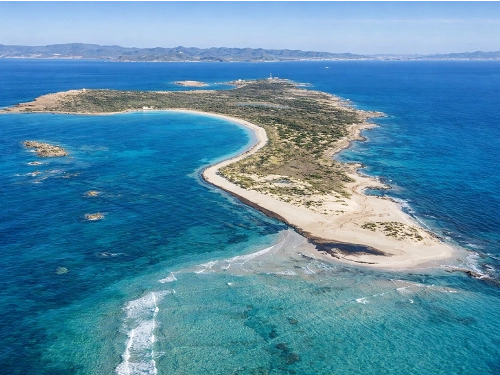
The island of s’Espalmador, located north of Formentera, is once again in the news with the start of renovation works on its only two houses. The project affects the historic homes known as s’Alga and Majoral, two buildings that are decades old and form part of the islet’s architectural heritage.
The intervention will take place in an environment that is particularly sensitive from both an environmental and heritage perspective. The islet is part of the Ses Salines Natural Park of Ibiza and Formentera and is subject to multiple protection regulations, which require the project to comply with strict technical, archaeological, and landscape conditions.
The urban planning license to carry out the work has been granted after several years of administrative processing and with numerous conditions imposed by the island authorities. The main objective is to allow the rehabilitation of the buildings without altering the essence of the landscape or the natural value of the site.
The developer behind this project is the current owner of the islet, a company linked to a Belgian business family that purchased s’Espalmador in 2018 for a multimillion-euro sum. However, the history of the place goes back much further, with several owners who kept the islet virtually untouched for decades.


Renovation project
The works focus on the comprehensive rehabilitation of the two existing homes on s’Espalmador: s’Alga and Majoral. Both buildings are listed within the island’s planning regulations, which requires their essential architectural characteristics to be preserved.
The intervention has had authorization from the Consell Insular de Formentera since January 2025, following the review of various technical and legal reports. The administrative process began in July 2020, when the owning company applied for the license to rehabilitate the properties.
The project has been designed by Formentera architect Marià Castelló and focuses on restoring buildings constructed before 1956. These buildings are considered legal within the current urban planning framework and are included in the territory’s protection catalogue.
One of the key aspects of the authorization is that the renovation does not alter the existing planning parameters. The works are limited to rehabilitating and improving the buildings already present on the island without increasing volumes or modifying the structure of the site.


Archaeology and conservation
Due to the historical value of the site, the project incorporates several requirements related to the protection of archaeological heritage. Before the works begin, an archaeological excavation will be carried out to document any possible historical remains beneath the surface.
During the execution of the works, permanent archaeological supervision will also be required. Any discovery must be recorded and incorporated into the documentation of the site.
Authorities also require the preservation of several original elements of the houses. These include the traditional pillars of the s’Alga house and rural structures such as animal pens and enclosures located near the same dwelling.
These measures aim to ensure that the renovation respects the historical identity of the buildings, many of which are linked to the former agricultural uses of the islet.
Environmental limitations
The location of s’Espalmador within the Ses Salines Natural Park means the project is subject to extensive environmental regulations. The intervention must respect both the landscape and the fauna and vegetation of the surrounding area.
Among the established conditions are restrictions on noise and activities that could affect the species present in the park. Actions that alter the natural profile of the land or modify existing vegetation are also prohibited.
Regulations also require that areas not occupied by buildings remain in their natural state. In forest areas, the woodland must be maintained and managed to reduce the risk of wildfires, while agricultural areas must remain suitable for traditional crops.
Even construction materials are regulated. Facades must respect the traditional aesthetic of the Pityusic Islands, using exposed stone or whitewashed finishes and avoiding modern cladding or striking colors that would disrupt the landscape integration.

Current owners and the history of Espalmador
The island of Espalmador currently belongs to the company Salga Majoral S.L., controlled by the Luxembourg-based firm CFdE S.A. and linked to the Belgian business family Cigrang. This investment group acquired the islet in 2018 for around 18 million euros, after public administrations decided not to exercise their right of first refusal to purchase the island.
Before that transaction, s’Espalmador had remained in the hands of the Cinnamond family for more than eighty years. The Catalan architect Norman Cinnamond bought the islet in 1932 from Carlos Tur Roig for around 42,000 pesetas. During that entire period the island remained practically untouched and without tourist development, which helped preserve its natural character.
With about 137 hectares and nearly three kilometers in length, s’Espalmador today represents one of the most unique spaces in the Balearic archipelago. Although it is privately owned, the islet has one of the highest levels of environmental protection, as it forms part of the Ses Salines Natural Park and the Natura 2000 Network, and is also designated as a Special Protection Area for Birds.
These restrictions prevent tourist development and mean that the island contains only two houses and a few heritage elements such as the Torre de Sa Guardiola. In this context, the renovation of the historic houses is presented as a very limited intervention aimed at preserving the existing buildings without altering the natural balance of the site.

I’m Ramón Tur, the person behind everything written and photographed on this website about Formentera. I discovered the island in 1972 when my parents, aboard the mythical Joven Dolores, took me on vacation from Ibiza for the first time, and it was love at first sight that has only grown stronger over time, making Formentera my place of residence for many years now. If you wish, you can follow me on Instagram @4mentera.com_
If you're planning to visit Formentera, make sure to check out our discount codes section first.


