

Formentera, May 15, 2026
The coastline of Formentera returned to some degree of normality yesterday after the removal of a huge pipe that had been stranded for months in the Cala en Baster area. The structure appeared following the severe winter storms that hit the sea last February and had since remained trapped among the rocks in this well-known stretch of the island’s coastline.
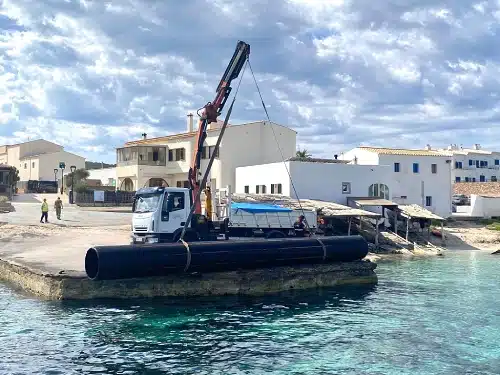
The operation began early on the morning of Thursday, May 14, when a vessel operated by Formentera Divers towed the pipeline from Cala en Baster to the small dock at Es Caló. A large team coordinated by the Environmental Department technicians of the Consell Insular de Formentera was waiting there to supervise the entire extraction and removal process.
The pipe, approximately 12 metres long and extremely heavy, had raised concerns both because of its environmental impact and the danger it posed to navigation. Its enormous size and weight could have become a serious hazard for any vessel colliding with it at sea.
The complex removal operation lasted several hours due to the dimensions of the structure, which almost occupied the entire width of the dock at Es Caló. Throughout the process, the workers operated with extreme caution to prevent the extraction and subsequent cutting of the pipe from causing further damage to the marine environment.


Cala en Baster – Es Caló
The operation began at around nine o’clock in the morning. The Formentera Divers vessel slowly managed to move the large pipe from the rocks at Cala en Baster to the dock at Es Caló, where all the necessary infrastructure had been prepared to complete the removal.
Images from the operation showed the complexity of the work. The dark-coloured pipe, featuring several orange lines along its exterior, was secured using heavy-duty slings while a crane truck carried out the lifting manoeuvres and positioned it onto the dock.
Technicians from the Consell Insular supervised every stage of the operation to ensure the process was carried out with maximum safety both for the workers and for the natural environment.


Characteristics of the pipe
Although the exact origin of the pipeline removed at Es Caló is still unknown, its appearance suggests it may be an HDPE pipe — high-density polyethylene — a material widely used in marine hydraulic infrastructure because of its resistance to corrosion and harsh sea conditions.
The orange lines visible on the outside of the pipe reinforce the theory that it may be linked to sanitation systems, submarine outfalls, desalination plants or industrial non-potable water pipelines. In addition, its large diameter and thick structure indicate that it was designed to transport large volumes of water, something commonly seen in this type of marine installation.
Environmental protection measures
One of the most notable aspects of the operation was the care taken to minimise any additional environmental impact. Before cutting the pipe, the teams deployed protective tarpaulins and containment systems to prevent fragments or waste material from ending up in the sea.
In addition, a specialised worker remained on site throughout the operation carrying out cleaning and monitoring tasks to collect any possible debris generated during the work.
The pipe was ultimately divided into three sections of approximately four metres each, making both handling and transportation easier.
Transfer to the landfill
Once the cutting process had been completed, the different sections of the pipeline were loaded and transported to the landfill site located in the Es Cap de Barbaria area.
There, they will be processed and managed according to the composition of their materials, as the exact origin of this massive structure that appeared in the waters of Formentera following the winter storms remains unknown.
The operation also stood out for the professionalism of all the teams involved. Both the workers and environmental technicians carried out meticulous and coordinated work to remove an object that, in addition to altering the coastal landscape for months, represented a potential threat to the marine ecosystem and to the safety of vessels navigating through the area.

I’m Ramón Tur, the person behind everything written and photographed on this website about Formentera. I discovered the island in 1972 when my parents, aboard the mythical Joven Dolores, took me on vacation from Ibiza for the first time, and it was love at first sight that has only grown stronger over time, making Formentera my place of residence for many years now. If you wish, you can follow me on Instagram @4mentera.com_
If you're planning to visit Formentera, make sure to check out our discount codes section first.


